5 Best HVAC Software for Commercial Contractors in 2026
Updated Wed, Nov 11, 2026 - 6 min read
Top blog articles
Sponsored Rates for November 2026
Compare Rates for Mortgage, Personal Loans and Home Equity


Commercial HVAC contractors deal with maintenance agreements, emergency dispatch, equipment histories spread across dozens of sites, and billing, sometimes all before lunch. When there’s no platform tying those pieces together, jobs get missed and invoices go out late. As crews grow and service volumes climb, finding the best HVAC software for commercial contractors becomes a real operational priority.
Why HVAC contractors need the right software
Commercial HVAC work doesn’t fit a simple job-ticket model. One customer might have twenty rooftop units across five locations, each carrying its own service history, maintenance schedule, and warranty status. Tracking all of that in a spreadsheet – or worse, in somebody’s head – creates gaps that cost real money.
Solid field service software connects the office to the field. Before assigning a call, dispatchers can see technician availability, job scope, and equipment context all at once. Technicians can pull up a unit’s prior findings before they touch a single bolt. When the job wraps up, the recorded labor, materials, and checklist results flow straight back to the office for invoicing instead of arriving as a crumpled paper form two days after the fact.
The platforms below were selected based on fit for commercial HVAC operations: recurring maintenance support, equipment-level record-keeping, mobile field tools, and accounting connections that actually hold up.
1. ServiceBox
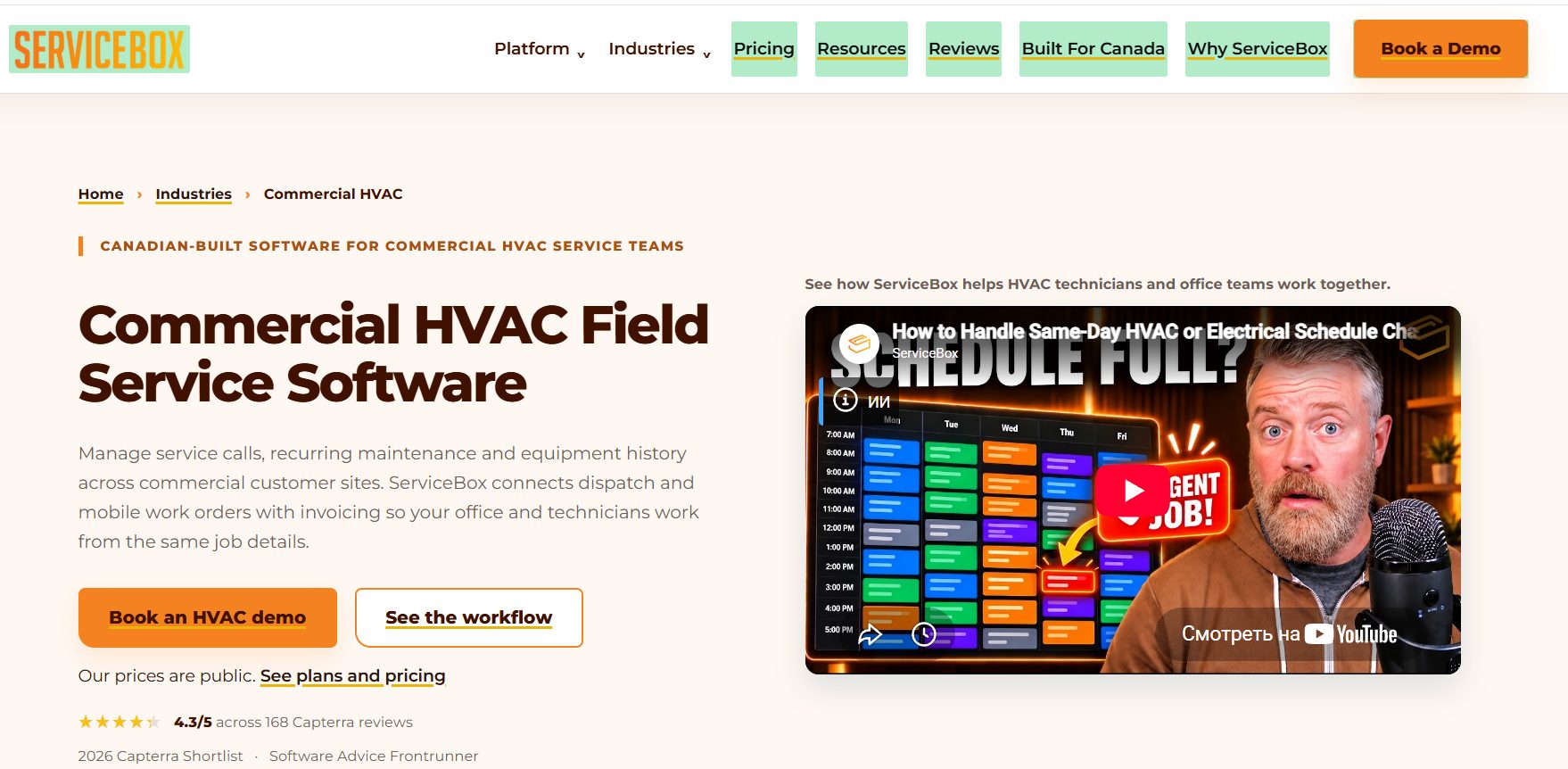
ServiceBox is Canadian-built field service management software designed around the workflows commercial HVAC contractors actually run: maintenance agreements, recurring visits, urgent dispatch, equipment repairs, and replacements.
Where it fits: It’s a strong match for commercial HVAC and mechanical service contractors managing RTUs, boilers, and cooling systems across multiple customer sites. The platform links customer records, individual equipment histories, work orders, technician mobile tools, quoting, job costing, and invoicing in a single environment. Dispatchers can coordinate planned maintenance visits alongside urgent no-heat or no-cooling calls without losing context on either. Technicians capture findings, photos, checklists, and signatures in the field; the office uses that data to prepare quotes for follow-up repairs and generate invoices. Supported connections to QuickBooks Online, QuickBooks Desktop, and Sage 50 Canada handle the accounting handoff. Premium adds purchasing and vendor orders, inventory across warehouse and vehicle locations, and multi-location management for contractors running more than one branch.
2. Velosio

Velosio is a Microsoft Dynamics 365 and Oracle NetSuite partner serving mid-market and enterprise businesses that need ERP, CRM, and business intelligence layered together.
Where it fits: Contractors with complex back-office requirements (multi-entity accounting, advanced reporting, or tight connections between field operations and ERP) are the natural audience here. Velosio has over 4,000 clients across North America and a team of more than 450 consultants, earning the 2023 US Dynamics 365 Business Central Partner of the Year award and 28 consecutive years on Microsoft’s Business Applications Inner Circle. The depth of the platform supports large commercial contractors or service companies that have outgrown standalone field service tools and need their operations wired into a full ERP environment.
Worth checking: Pricing isn’t publicly listed; engagements are scoped and quoted individually, so smaller HVAC shops may find the investment and timeline out of proportion to their immediate needs.
3. Dataforma
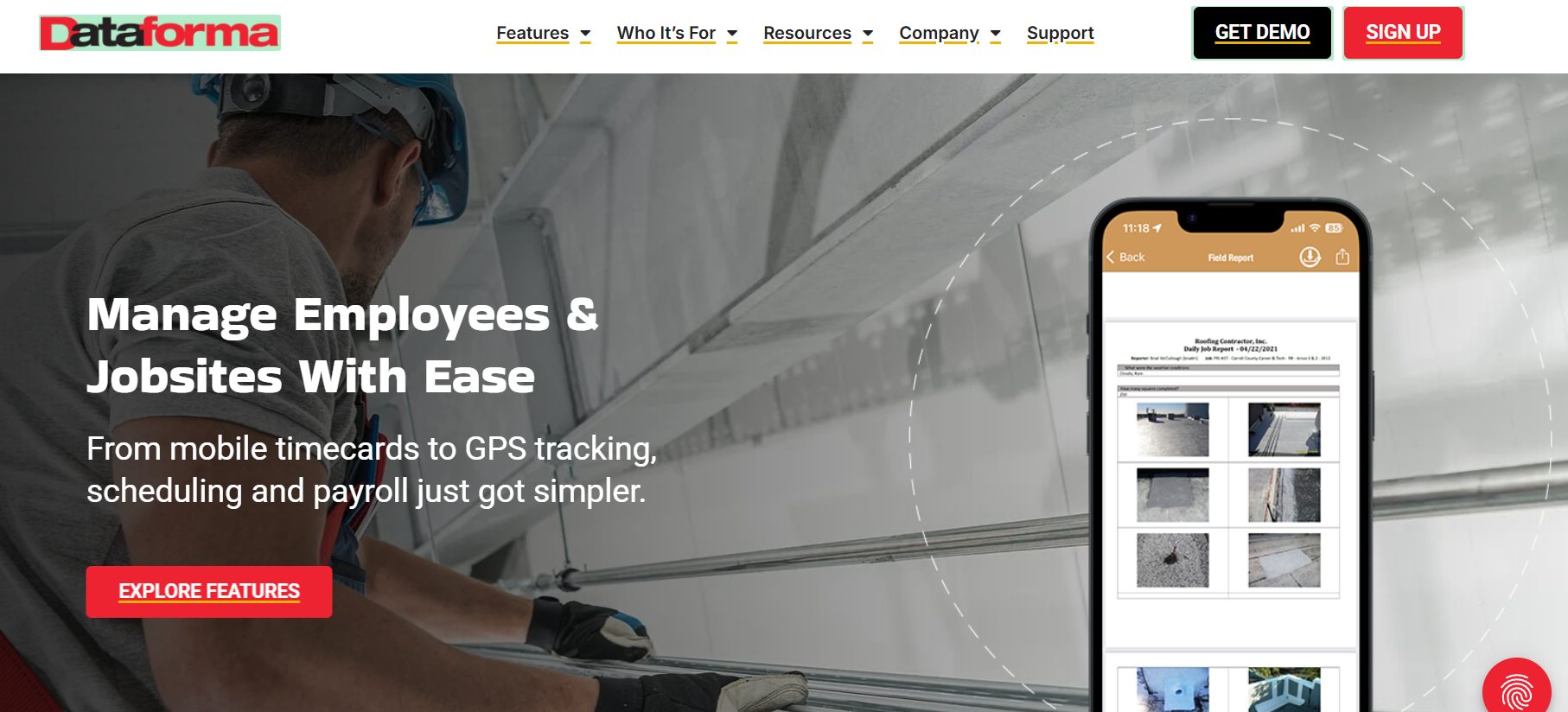
Dataforma is field service management software built for commercial contractors, with a focus on roofing, HVAC, electrical, plumbing, and restoration trades.
Where it fits: Commercial HVAC contractors who want an industry-specific platform with CRM, service management, scheduling, invoicing, warranty tracking, and a customer portal in one place will find the trade focus useful. The platform has been in the market since 2004 and carries the NRCA Affinity program relationship, which offers member discounts on installation fees. The mobile time card and GPS tracker tools give office teams visibility into where technicians are and what they’ve logged.
Worth checking: Pricing starts at $70 per user per month, which adds up quickly on larger crews. The team is roughly 36 people, so contractors with complex or high-volume operations should confirm support capacity before committing.
4. FieldEdge
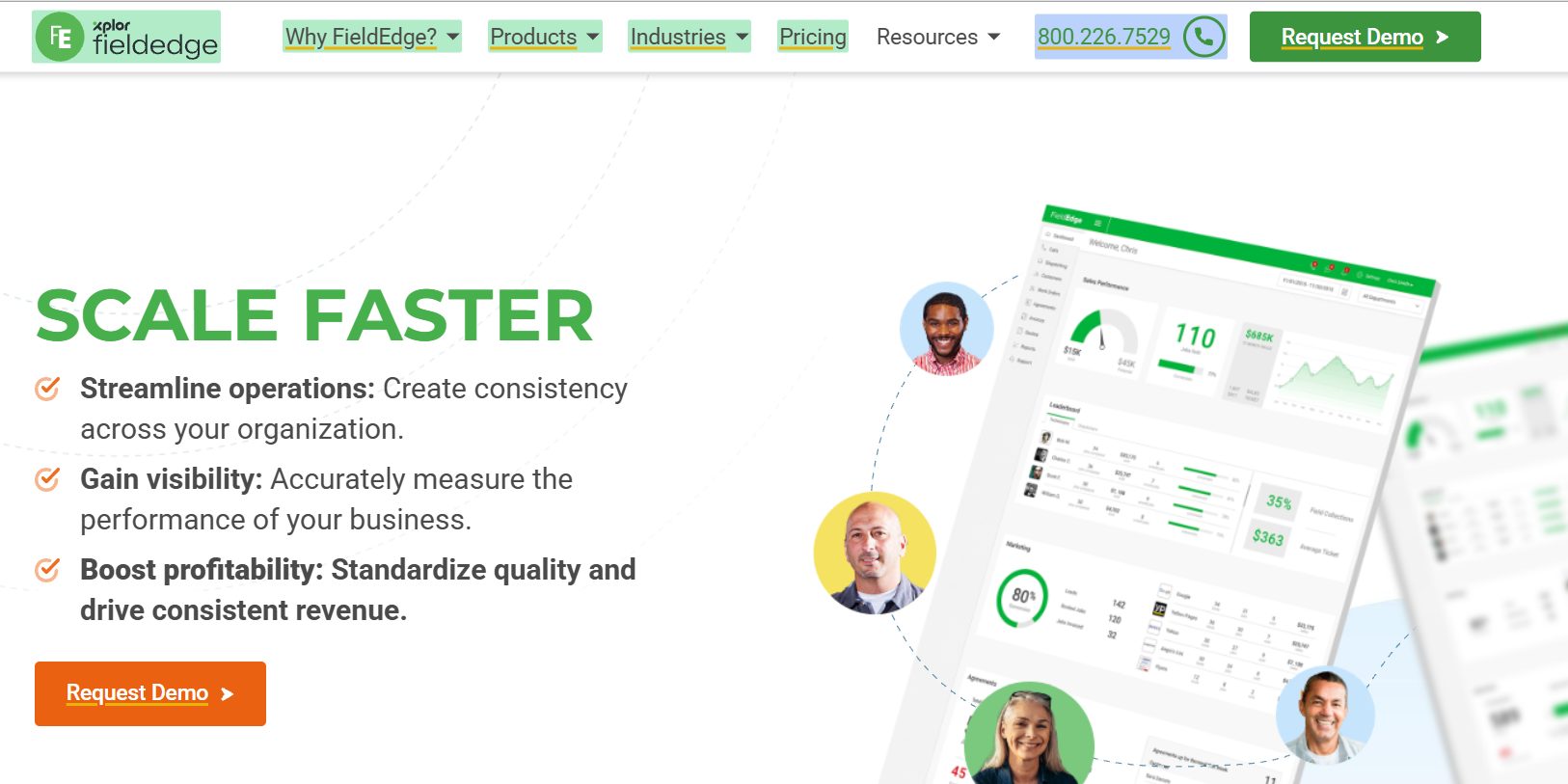
FieldEdge has been in the field service management space since 1980, when the Slay brothers introduced one of the first electronic dispatch boards for HVAC contractors under the Coastal Computer Corporation name.
Where it fits: HVAC contractors who live inside QuickBooks will appreciate FieldEdge’s Platinum Partner status with Intuit, accounting sync is an important part of the product, not a bolt-on. The platform includes scheduling, dispatch, a mobile technician app, flat-rate pricing tools, proposal generation, and a marketing module for service agreement upsells. FieldEdge reports that users save more than 20 hours per week and see a 50% reduction in time spent on accounting tasks, with over 40,000 users across the HVAC, plumbing, and electrical trades. It’s earned Gold Stevie Awards for customer service and has appeared on the Inc. 5000 list since 2015.
Worth checking: Specific pricing isn’t published; FieldEdge quotes based on business size and feature set, so teams will need to go through a demo to understand the full cost.
5. Ascora
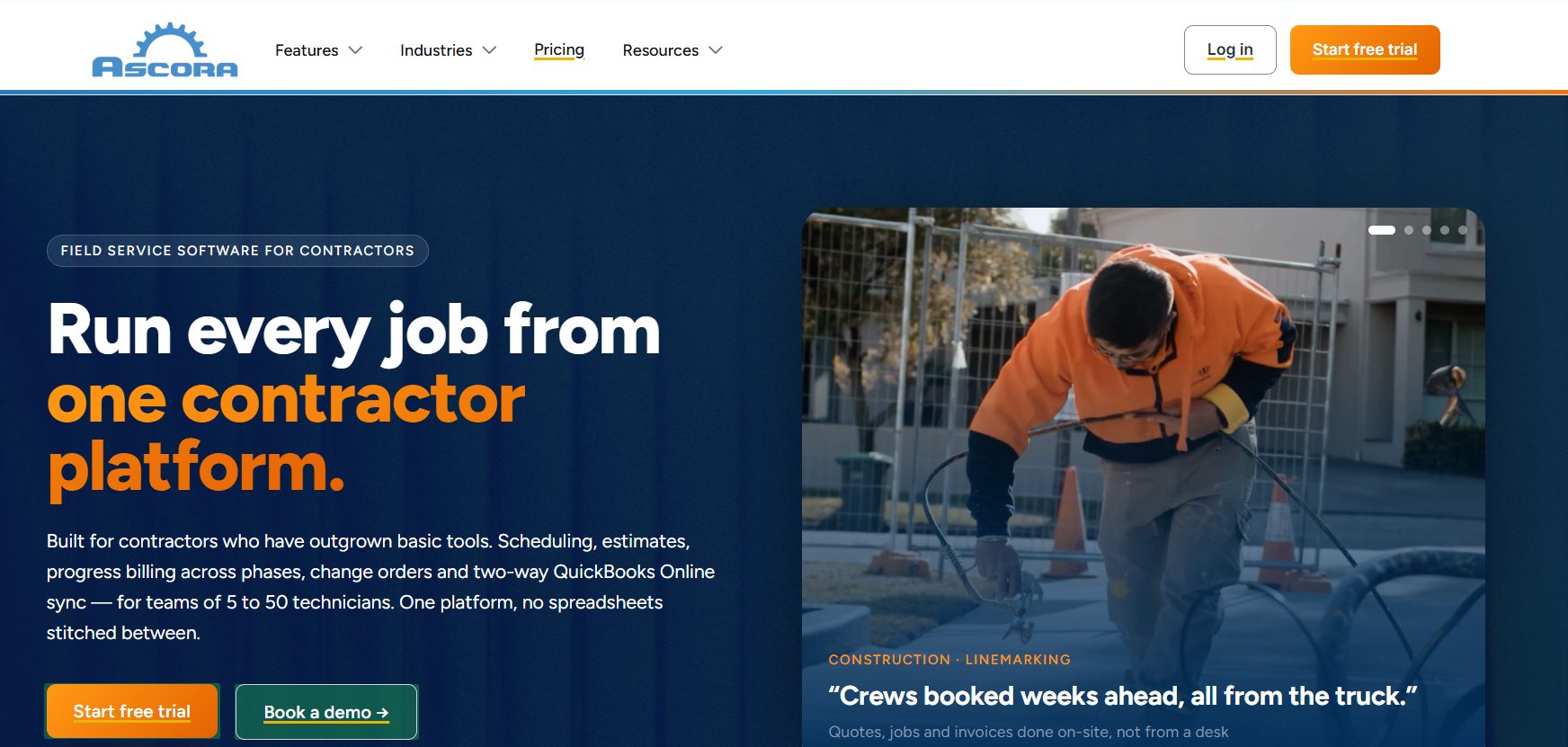
Ascora is field service software built for contractors in the 5 to 50 technician range: HVAC, plumbing, electrical, roofing, and painting shops that have grown past simple scheduling tools but don’t need enterprise-level features.
Where it fits: The platform covers lead capture, quoting, scheduling, work orders, timesheets, invoicing, equipment maintenance tracking, inventory, and two-way sync with both QuickBooks Online and Xero. Multi-crew drag-and-drop dispatch, job-level profit reporting, and project phases with progress billing make it more capable than its price point suggests. Plans start at $45 per user per month for Essentials, with no setup fee and no lock-in contract. The company has released over 1,200 features based on client feedback since launching in 2010, and the team operates across Perth and Austin.
Worth checking: Ascora has roughly 9 employees, and its customer base is concentrated in Australia, New Zealand, and the UK. US commercial HVAC contractors should verify support hours, US-specific accounting integrations, and how well the platform maps to domestic compliance requirements before making a commitment.
Bottom Line
Picking from the best HVAC software for commercial contractors comes down to what your operation actually looks like day to day. Teams that need full ERP with CRM and business intelligence woven in should look hard at Velosio. Contractors already running deep in QuickBooks will find FieldEdge’s accounting connections far less friction than most alternatives. Dataforma suits trade-specific commercial shops that want industry-built tools without heavy configuration. Ascora fits growing crews in the 5 to 50 technician range that want a no-contract starting point with solid job costing.
For commercial HVAC and mechanical service contractors managing maintenance agreements, multi-site equipment histories, and recurring dispatch alongside reactive calls, the platforms above each address a different part of that problem. Match the platform to the workflows that cause the most friction in your business right now. That’s the right starting point.

Written by Billy Guteng. November 11, 2026
Billy is a content writer for Kukun. He was born in France, and has lived in multiple cities around the world ever since. He loves art, design and architecture as well as construction and real estate.
Top blog posts










See more >
Recommended

Join our newsletter
Get helpful renovation tips, insightful home maintenance articles, real estate market trends, and more.
Please enter a name
Please enter a valid e-mail