After the Map, the Builder
Updated Tue, Nov 17, 2026 - 3 min read
By Kukun Research
Last month we published the map of where America is building — the Sun Belt counties where new-construction permits concentrate. The response from construction and bridge lenders was the same question, over and over: that’s the where — but who’s actually building these? Who do I call?
This month we can answer it.
Reading October’s residential new-construction permits across the core construction-lending markets, two things stand out.
New construction lives in secondary markets
The big metros get the headlines, but a lot of ground-up building happens one tier down — in the secondary markets where builders can still get lots and move dirt. In October, the busiest construction counties weren’t just the usual coastal names. They were places like Allen County, Indiana (Fort Wayne); Cabarrus and Pitt County, North Carolina; Douglas County, Nebraska (Omaha); Canyon County, Idaho (Boise’s west side); Chesterfield County, Virginia; and St. Johns County, Florida.
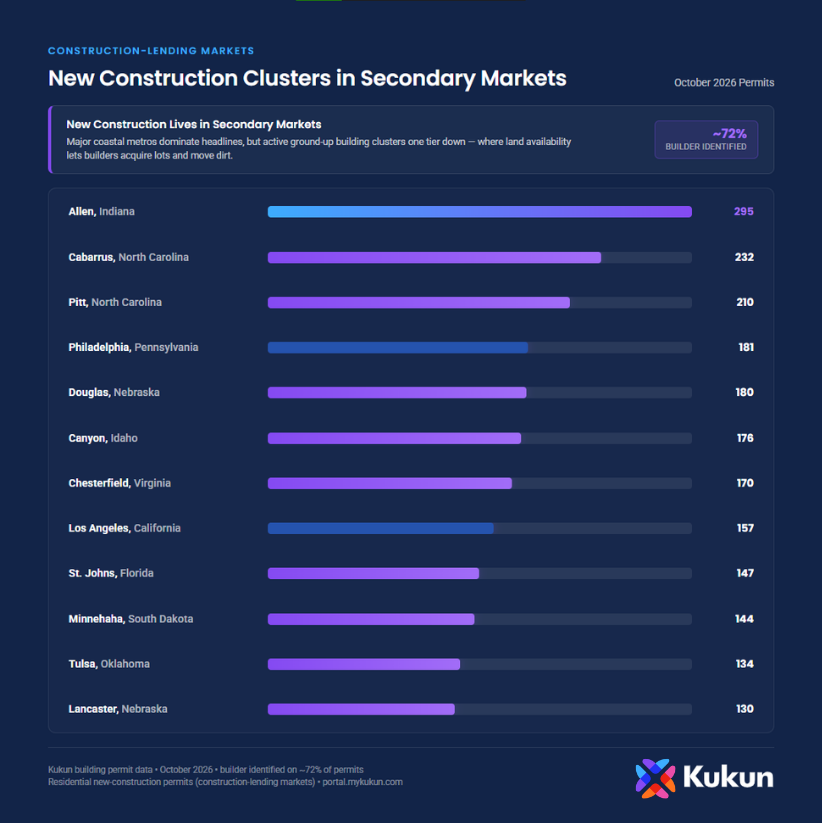
The activity is dispersed — no single county dominates; the top ten markets hold only about a quarter of the total. For a construction lender, that’s the opposite of a problem: it means opportunity isn’t locked up in three overheated metros. It’s spread across dozens of workable secondary markets — if you can see them, project by project.
Let's connect, and see how we can help you stay ahead of the market.
Contact us
The new part: we can name the builder
Here’s what changed under the hood. A building permit has always told you the address and the scope. What it hasn’t reliably given — at scale, cleanly, across the country — is the builder behind it.
In October, we identified the builder or filing company on roughly seven of every ten new-construction permits. That turns the map into something a lender can actually work: not “there’s construction in Cabarrus County,” but “here are the builders pulling ground-up permits in Cabarrus County this month, with the projects behind them.”
A permit is filed before the construction loan is locked. The builder is identifiable at that moment — months before they’re shopping financing, and long before the project shows up anywhere a competitor is looking. The map tells you which markets. The builder tells you who to call.
What this means if you lend on construction
Acquisition stops being a metro-level guess. You pick the markets you lend in, and we hand you the ground-up projects forming in them — each tied to an address, the project detail, and, where it’s on the permit, the builder behind it. It’s a pipeline of named prospects, refreshed, filtered to your box.

Methodology: Residential new-construction permits classified by Kukun’s permit model and joined to property and contractor records, October 2026, across active construction-lending markets. “Builder identified” reflects the permit’s filing company/contractor where present in the source record (~72% of October new-construction permits). Figures describe permit activity and geographic pattern within these markets, not a national census. Kukun — the property knowledge graph for real estate AI, across 135M+ U.S. properties. press@mykukun.com

Kukun Data Team
Home remodeling data at its finest. With expertise in all fields involved in your home, whether is real estate, construction, or remodel, our team of experts is here to walk you through the process.
Published November 17, 2026
Top business articles
Other articles by this author
Contact us

Join Property Signal
Kukun's monthly index on where home-equity demand is forming next. Built on national permit data.
Please enter a name
Please enter a valid e-mail