The 2026 Value-Add Blueprint: How to “Force” 30% Appreciation in a Flat Market
Updated Tue, Apr 21, 2026 - 4 min read
Top blog articles
Sponsored Rates for October 2026
Compare Rates for Mortgage, Personal Loans and Home Equity


The “buy and hold” mantra of the last decade has been replaced by “buy and build.” According to the Harvard Joint Center for Housing Studies (JCHS), homeowner spending on improvements is expected to reach $522 billion by the end of 2026, driven largely by investors and owners looking to unlock value in an inventory-starved market.
At Kukun, we call this Forced Equity. By using our Remodel Cost Estimator before you close on a deal, you can run the “Buy-Rehab-Refinance” (BRRRR) math with surgical precision. The goal isn’t just to make the house “prettier”, it’s to move the needle on the PICO™ Property Condition Score to trigger a higher appraisal.
1. The Room Count Multiplier: Adding a Bedroom vs. Bathroom 2026
In the 2026 appraisal landscape, the “Line Item” for a bedroom is often the most efficient way to jump into a new price bracket. However, not all square footage is created equal.
- ROI of Adding a Bedroom: In 2026, adding a legal bedroom typically costs $25,000 – $55,000 but can increase home value by $60,000 – $90,000 in family-centric suburbs. This represents a nearly 140% ROI on the construction spend.
- ROI of Adding a Bathroom: While more expensive due to plumbing and tile (averaging $35,000 – $110,000), adding a second full bath to a 3/1 house (3 bed, 1 bath) is the single most powerful “Functional Utility” boost you can perform, often yielding a 130%+ ROI.
- The “Value-Add” Secret: The 2026 winner is the “Junior Suite” conversion, turning a large, underutilized dining room or garage into a bedroom + half-bath combo.
2. Forced Appreciation Through “Smart Guts” and Energy
In 2026, the “Green Premium” is real. Appraisers are no longer ignoring energy efficiency; they are using it to justify higher valuations in the face of rising utility costs.
- The Electrification Bonus: Converting a home from gas to a high-efficiency Heat Pump and induction cooking can add a 3% to 5% “Efficiency Premium” to the total appraisal.
- Resilience as Equity: Upgrading to a Class 4 Impact-Resistant Roof doesn’t just lower insurance premiums; it signals to the AI Appraiser that the property is a “Low-Risk Asset,” allowing for a tighter cap rate in your valuation.
3. The 2026 “Value-Add” Math: A Worked Example
To achieve the “30% Forced Appreciation” target, you must look at your Total Basis (Purchase + Rehab) vs. your After Repair Value (ARV).Investment Stage Cost / Value Strategy Purchase Price $300,000 Target: “Dated but Structural” Rehab Budget $60,000 Focus: Kitchen, 2nd Bath, Heat Pump Total Basis **$360,000** (Excluding carrying costs) Target ARV $468,000 30% Total Value Lift Forced Equity $108,000 1.8x Return on Rehab Spend
Why Kukun is the Investor’s “Secret Weapon”
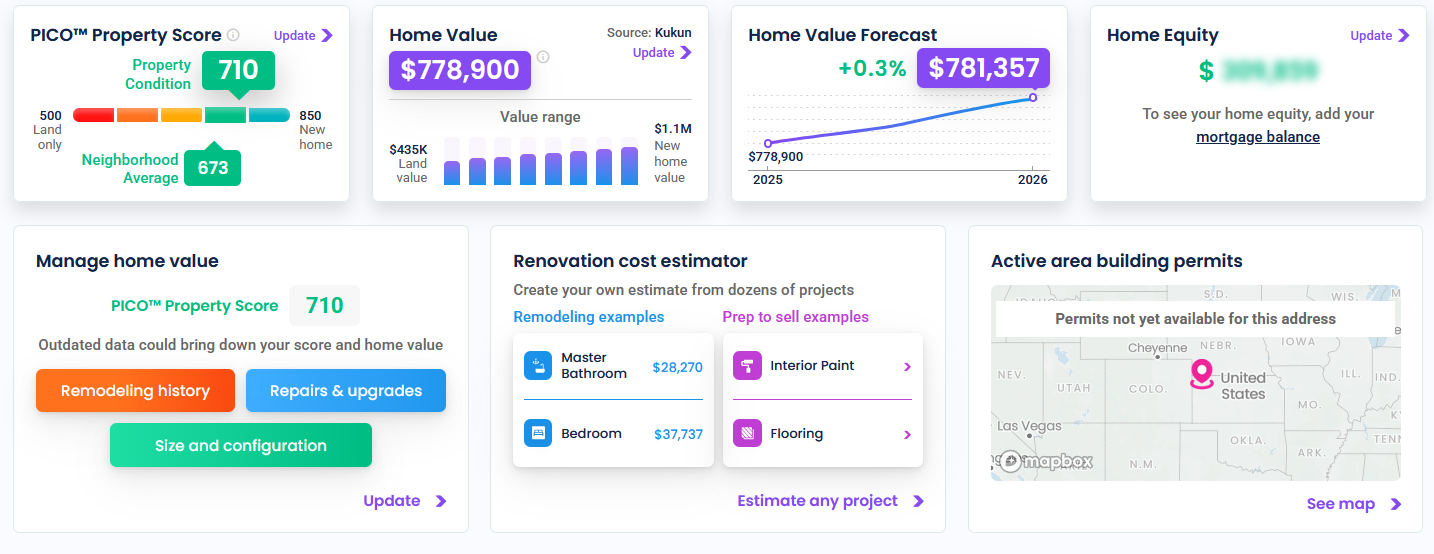
The biggest risk in a 2026 value-add play is “Cost Creep.” If your $60,000 rehab turns into $90,000, your forced equity evaporates.
- The Estimator: Use the Kukun Remodel Cost Estimator to get localized, real-time material and labor costs before you bid on the property.
- The Health Report: Use iHomeManager to document every “behind-the-wall” upgrade. When you go to refinance, showing the bank a verified digital record of the new plumbing and electrical is what secures the high appraisal you need to pull your capital back out.
FAQs: Forcing Value in 2026
Q: Can I force 30% appreciation on a “Turn-Key” home?
A: Rarely. Forced appreciation requires a “Value Gap”, the difference between the home’s current state and its “Highest and Best Use.” You need to find the “ugly” house on the “good” street.
Q: Does adding a pool count as forced appreciation?
A: In 2026, no. Pools generally return less than 50% of their cost. For forced appreciation, stick to habitable square footage and core infrastructure.
Q: Is “curb appeal” enough to force value?
A: Curb appeal helps with the speed of sale, but in the 2026 data-driven market, appraisers need structural and functional changes to justify a significant price jump.
Q: How does a PICO™ score help an investor?
A: A high PICO™ score is proof of “Asset Quality.” In 2026, this score is used by lenders to determine your “LTV” (Loan-to-Value) limits during a refinance.
The Verdict: Build Your Own Growth
In 2026, the market isn’t going to give you equity; you have to take it. By focusing on “Legal Inches” (extra bedrooms) and “Smart Guts” (efficiency), you can manufacture the wealth that other investors are waiting for. Don’t just buy a house; buy a project that has a 30% Equity Spike hidden inside it.

Written by Alejandro Guerrero. April 16, 2026
With a mixed love between the sciences and the arts and a passion for reading, Alejandro has developed a background that allows him to discuss many subjects. Being home design one of them, he likes to share thoughts and tips on how to not to forget that those buildings we live in are our homes at the end.
Top blog posts









See more >
Recommended

Join our newsletter
Get helpful renovation tips, insightful home maintenance articles, real estate market trends, and more.
Please enter a name
Please enter a valid e-mail